





 Русский


Plastic Extrusion Defects and Solutions
Plastic Extrusion Defects and Solutions
Plastic extrusion is a continuous high-volume manufacturing process. A thermoplastic material (powder, pellets, or granulates) is homogeneously melted and then forced out of the shaping die through pressure.
The majority of the extrusion processing steps occur within the machine. Due to the complexity of the processing method, plastic extrusion defects will eventually occur.
In this article, we will mainly discuss the common plastic extrusion defects and how to improve the process.

The main plastic extrusion defects
To ensure the quality of extrusion manufacturing, the operator needs to identify, control, and monitor all quality parameters.
There may still be several extrusion defects even with a stable process. The common defects in plastic extrusion are due to three main causes: mold design, material selection, and processing. Most failures appear during the processing stage. Here, we have listed some of the most common defects in extrusion:
l Improper system engineering: This category comprehends many different problems such as utilizing the wrong clamp, overly tight clamp, improper die setting, use of incompatible fire caulk, and contact the outside pipe with incompatible material. By improperly carrying out operations, it may lead to centering problems and chatter marks on the product.
l Improper operation: The improper operation will cause uneven surface thickness. The result may be caused by exposure to freezing temperatures without freeze protection, over-pressurization, or pulsating water pressure.
l Resin defects: Resin flaws results in blowholes formation on the product. The defect can be attributed to poorly distributed filler, foreign contamination, improper mixing of resin and additives.
l Improper material addition: This issue occurs when materials absorb the moisture from the air, eventually causing bubbles on the surface.
l Surging: Surging is a cyclical product thickness variation in the direction of extrusion. The surge cycle time is typically between 30 seconds and 3 minutes.
l Poor mixing: The flaw will lead to clogging the extrusion. The screw cannot be run faster because poor mixing will cause the material to have a striped surface, parabolic ridges, and particles of undispersed additives.
l Melt fracture: Melt fracture refers to fine ridges or rough surfaces when the melt comes too fast out of a thin die.
l Overheating: The defect may produce degradation, make dimensional control and sizing difficult. Overheating may limit the rate when the take-off cooling is limited.
l Moisture absorption: The situation will cause a pattern of dotted lines, long bubbles, and pits on the surface. A moisture level of 0.1% is usually low enough to avoid such visual problems.
l Trapped air: A trapped-air surface will show bubbles and pits on the material. This defect occurs because of air goingthrough the machine when operating at high speed.
Suggestions on how to improve the process of plastic extrusion
Preventative measures
Before acting on specific extrusion defects, the maintenance staff should solve certain issues. It is important to diagnose plastic extruder defects quickly and accurately to minimize production downtime or off-quality product.
Here, we share some of the preventive measures you may adopt:
1. Operators should fully understand the extrusion process: The incorrect operation may damage the extruder, and the product will consist of poor quality. Serious accidents will occur when extruders are not operating properly. People who operate extrusion equipment must receive comprehensive training.
2. Collection and analysis of historical data: The data to be collected include processing information from the extruder (temperatures, pressures, motor load, line speeds, barrel dimensions, screw dimensions) and information about the material.
3. Material storage: The material should be stored in a clean, dry area without being affected by extreme temperature variation.
4. Regular inspection of equipment and instruments: Equipment instruments used to monitor temperature, pressure, RPM, and amperage should be calibrated twice a year in case the data change over time.
5. The condition of the equipment: Maintenance records should be kept to assess the machine's condition. Extruder screws and barrels will wear over time. The operator should regularly measure the internal diameter (ID) of the barrel and the outer diameter (OD) of the screw to predict the life of the components.
The solution to plastic extrusion defects
When plastic extrusion defects appear with a normally stable process, the extrusion technician will usually troubleshoot by detecting current conditions.
The first step is to examine the equipment components of the manufacturing process. The following list is the main variables that need to be examined:
1. Melt pressure and temperature
2. The temperature of the barrel and die
3. Heater and cooling power
4. Speed of the screw and the line
5. The motor load in amps
6. Die wear or improper design
The following step is some solutions to remedy the problem:
1.Use the digital temperature sensor and pressure gauge
2.Adjust the die setting
3.Exact addition of resin material
4.Increase rpm back pressure for better mixing
5.Altering or replacing the screw
6.Installing a gear pump between the extruder and the die
7.Maintain the speed of the extruder
Why Do You Choose Boyu?
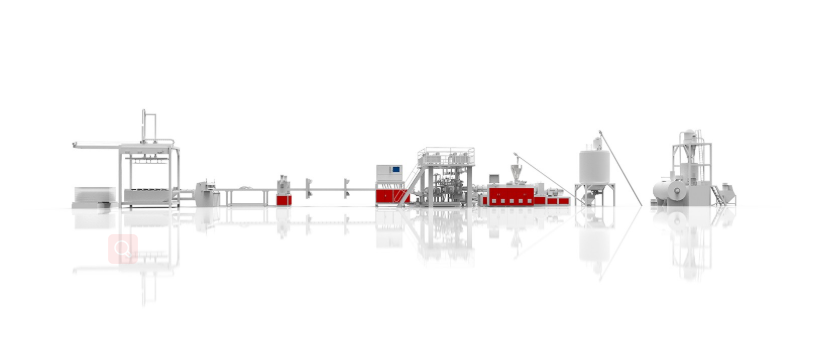
Boyu Plastic Machinery is a professional plastic extrusion machine manufacturer. Our company was established in 1998 and had over 20 years of plastic extrusion experience.
We specialize in the PVC Flooring Extrusion Production Line, and we are also acclaimed as the leader of SPC floor equipment. We have professional technical support with more than 90 technical international and national patents.
We are looking forward to becoming your reliable business partner, contact us!
